

My Pet’s Wound Won’t Stop Bleeding: When to Treat at Home and When to Come In
A bleeding wound has a way of making everything feel urgent at once. You are trying to stay calm, your pet is stressed, and you are not sure whether this is something you can handle at home or whether you need to be in a car right now. The honest answer is that most bleeding wounds respond well to prompt veterinary evaluation, and earlier is almost always better. Wounds that are seen and treated quickly are easier to close cleanly, carry lower infection risk, and are far less likely to reveal a deeper problem that a surface look missed.
At the Veterinary Emergency and Specialty Center of Northern Arizona, our team handles bleeding wounds and trauma frequently, from minor lacerations that need proper cleaning and closure to serious hemorrhage requiring urgent stabilization. If something about what you are seeing feels wrong, trust that instinct. Contact us at 928-779-5522 or come directly to our facility. We are here around the clock when your regular vet is closed, all weekend long.
What Does Normal Bleeding Look Like, and When Does It Become a Problem?
In a healthy pet, the clotting process begins within seconds of an injury. Platelets aggregate at the wound site, clotting factors activate in a cascade, and active bleeding typically slows noticeably within five to ten minutes of consistent direct pressure. That process is reliable when it works.
When it does not work, the signs are distinct. Bleeding that continues beyond ten to fifteen minutes of uninterrupted firm pressure, blood that appears unusually thin and will not thicken, or spontaneous bleeding without any identifiable injury are all signals that something beyond the wound itself may be happening. Understanding emergency care for pets starts with recognizing that normal clotting has a timeframe, and bleeding that exceeds it warrants veterinary evaluation rather than continued waiting at home.
What You Can Handle at Home
Minor scrapes, bleeding nails, and lacerations less than an inch in length that stop bleeding with a few minutes of pressure can generally be handled at home or wait for your regular vet. Bite wounds are an exception: if your pet was bitten, especially by a much larger animal, the underlying tissue damage is usually more severe than the surface puncture wound suggests and should be evaluated.
Nail and Minor Wound Home Care
Nail injuries are one of the most common causes of bleeding at home. Styptic powder applied directly to the nail tip and held with light pressure for one to two minutes is usually sufficient to stop minor nail bleeding. A broken or torn nail that extends toward the base, will not stop bleeding after fifteen minutes of pressure, or is causing significant pain warrants veterinary evaluation since the damaged portion needs to be properly trimmed back to allow healing.
For minor cuts and scrapes, cat scratches, small thorn punctures, and minor paw pad abrasions, gently flush the area with clean water or saline, pat dry, and apply a thin layer of antibiotic ointment if you can prevent licking. Skip hydrogen peroxide and alcohol, both of which damage tissue. An e-collar or a clean sock secured over a paw wound prevents the licking that keeps wounds from closing properly. Monitor for redness, swelling, warmth, or discharge over the following days, any of which suggests infection and warrants a veterinary visit.
Bleeding Emergencies: Signs That Mean Come In Right Now
Some situations do not have a home management step. If any of the following are present, move immediately:
- Bleeding that pulses or spurts in rhythm with the heartbeat, indicating arterial bleeding
- Wounds to the chest or abdomen
- Blood soaking through multiple layers of towels without slowing after firm continuous pressure
- Pale or white gums, which indicate the body is not circulating oxygen effectively
- Rapid or labored breathing alongside bleeding
- Collapse, extreme weakness, or cold extremities
- Bleeding from multiple locations without obvious injury
These presentations indicate significant blood loss, internal hemorrhage, or shock, any of which can become fatal without prompt intervention. Call us at 928-779-5522 while heading in so we can prepare for your arrival.
Bleeding That Has No Visible Wound
Not all serious bleeding looks like a cut.
- Nosebleeds that last more than a few minutes, recur without obvious cause, or are accompanied by facial swelling need same-day evaluation. They can indicate elevated blood pressure, a clotting disorder, a nasal mass, or a tick-borne infection.
- Vomiting blood, whether bright red or dark coffee-ground material, indicates active or recent bleeding in the upper gastrointestinal tract and warrants urgent care, particularly if accompanied by lethargy or pale gums. Gastrointestinal ulceration is one of the most common and underrecognized causes of blood in vomit or stool. NSAIDs, including aspirin and ibuprofen, and corticosteroids can erode the stomach lining, particularly when given at too high a dose, for too long, or in combination. A pet who has recently received any NSAID or steroid and is now vomiting blood or producing dark tarry stool should be evaluated promptly.
- Blood in stool presents as either bright red blood coating the stool (lower GI origin) or dark, tarry, foul-smelling stool (upper GI bleeding, typically more serious). Any significant volume of blood, combined symptoms, or a pet who seems unwell should be seen the same day, especially in puppies where this could signal parvo infection.
- Blood in the urine can stem from a bladder infection, bladder stones, a polyp or mass, or a clotting disorder. Blood in the urine combined with straining, frequent attempts with little output, or lethargy is an immediate emergency, particularly in male cats where a blocked urethra can become fatal within hours.
- Vaginal bleeding in intact female dogs during a normal heat cycle is expected. Discharge that is unusually heavy, foul-smelling, or accompanied by lethargy, increased thirst, or vomiting is not normal and may indicate pyometra, a life-threatening uterine infection requiring emergency surgery. Intact male dogs can also develop prostate disease causing blood in the urine or bloody discharge, which warrants same-day evaluation.
Pet First Aid for Bleeding Wounds: What to Do While Getting to Us
Good pet first aid reduces blood loss before arrival but does not replace veterinary care.
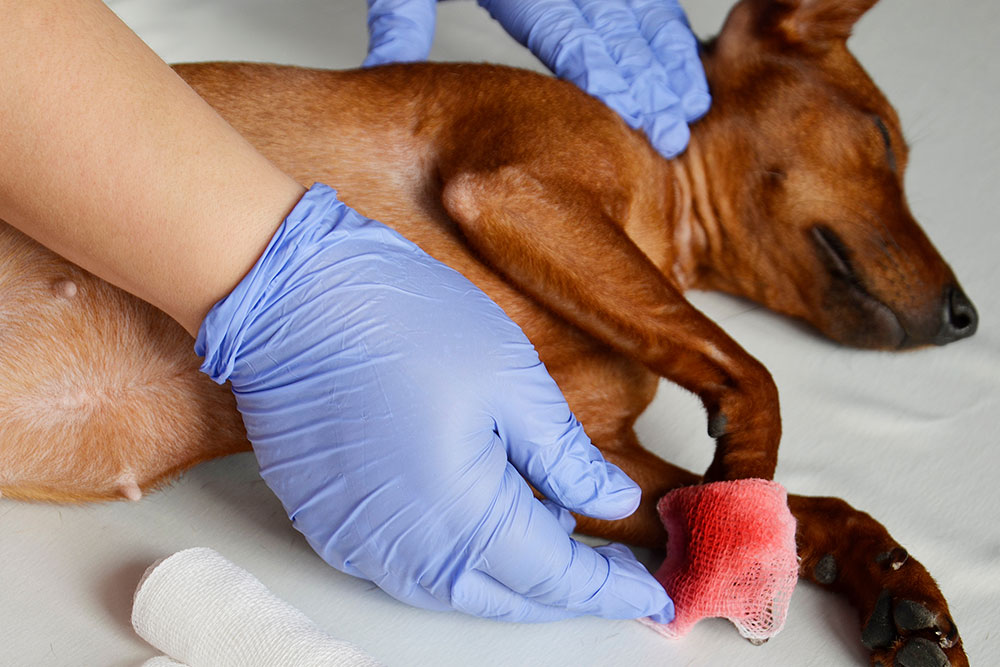
- Apply firm, direct pressure using a clean cloth, gauze, or towel. Hold without lifting for at least ten minutes continuously.
- Add material on top if blood soaks through rather than removing the first layer.
- Elevate a bleeding limb above heart level while maintaining pressure if possible.
- Keep your pet as calm and still as possible and call ahead so we can be ready.
Do not remove an embedded object, do not apply a tourniquet without veterinary instruction, and do not give human medications including aspirin, ibuprofen, or acetaminophen, all of which can worsen bleeding.
Bite wounds almost always need evaluation even when surface bleeding looks minor, since punctures close quickly and trap bacteria deep in tissue. Lacerations that appear superficial can involve underlying structures not visible without proper examination.
Health Conditions That Cause Excessive or Spontaneous Bleeding
Some pets bleed more than expected not because of the wound’s severity, but because of an underlying condition affecting the body’s ability to clot normally.
Blood Disorders That Affect Clotting
Immune-mediated thrombocytopenia specifically targets platelets, reducing their numbers to the point where clot formation becomes impossible. A pet with thrombocytopenia may bruise spontaneously, develop pinpoint red spots on the gums or skin, or bleed excessively from even a small wound.
Inherited coagulation factor disorders also produce unexpectedly severe bleeding relative to the injury. Von Willebrand disease involves a deficiency of the protein that helps platelets adhere to damaged vessel walls, while hemophilia involves deficiencies of specific clotting factors. Both can cause excessive bleeding after minor injuries, surgery, or nail trims, and in some cases spontaneous bleeding from the nose or gums.
Liver disease impairs the production of clotting factors, since the liver synthesizes most of them. A pet with significant hepatic dysfunction may bleed more than expected from routine wounds or procedures, and the problem often goes unrecognized until something triggers active bleeding.
Disseminated intravascular coagulation (DIC) is a catastrophic breakdown of the clotting system triggered by severe infection, trauma, snake envenomation, or organ failure, producing a pet who is simultaneously clotting where they should not and unable to clot where they need to. It carries a serious prognosis and requires intensive hospitalization, plasma transfusions, and treatment of the underlying trigger.
Ticks and Toxins
Rocky Mountain spotted fever and Ehrlichia can both cause platelet destruction and are worth considering in Northern Arizona when a clotting problem has no obvious mechanical cause. Our team is experienced in managing these regional disease concerns alongside the bleeding itself.
Rodenticide toxicity prevents the recycling of vitamin K that multiple clotting factors require. If there is any possibility your pet has accessed rat poison, share that information immediately. It changes the treatment approach entirely.
Snakebites
Snakebites are a particularly relevant cause of coagulopathy in Northern Arizona. Treating snake bites in pets is time-sensitive: rattlesnake venom contains enzymes that destroy tissue, disrupt platelet function, and interfere with clotting factor activity, producing life-threatening coagulopathy from what looks like a small puncture wound. Any pet with a known or suspected snakebite should be evaluated immediately, even if tolerating it well at first. Anti-venom administered early significantly improves outcomes.
Tumors and Cancer as a Cause of Bleeding
Masses near the surface can ulcerate and bleed persistently, particularly squamous cell cancer in cats. Internal tumors are an equally serious concern: hemangiosarcoma is a malignant tumor of blood vessel cells that commonly affects the spleen, liver, or heart in dogs and is one of the more frequent triggers of DIC. These tumors can rupture without warning, causing sudden internal hemorrhage with no prior signs of illness. Skin cancers benefit from early detection, and any wound not healing on a reasonable timeline or a mass that bleeds with contact warrants prompt evaluation.
When internal bleeding is suspected or a mass needs precise characterization before surgery, our CT scanner, the only one in Northern Arizona, provides detailed cross-sectional imaging that guides surgical decisions in a way standard radiographs cannot. Our surgical capabilities include biopsy and excision for concerning masses.
What Happens at the Veterinary Visit?
Triage on arrival assesses blood loss and cardiovascular stability immediately: gum color, capillary refill time, heart rate, and breathing effort all provide rapid information about how the patient is compensating.
Wound evaluation involves assessing depth, underlying structures, contamination level, and how long the wound has been present. Older wounds often cannot be closed primarily because the tissue edges are no longer viable or bacterial colonization has progressed. For cases where bleeding has no obvious external source or the extent of internal injury is unclear, our CT scanner provides immediate, detailed imaging of body cavities, vessels, and soft tissue that rules out injuries that would otherwise remain invisible. Our trauma and urgent care capabilities cover the full range, from straightforward laceration repair to complex cases involving damaged vessels or underlying conditions.
Testing and Treatment for Clotting Problems
When an underlying disorder is suspected, bloodwork provides the clearest answers. A complete blood count quantifies red blood cells, white blood cells, and platelets. Coagulation panels identify where in the cascade the process is failing. Additional testing may include liver function panels, toxin screening, or tick-borne disease panels.
Treatment is matched to the diagnosis:
- Traumatic wounds: cleaning, closure or open wound management, pain control, and antibiotics as indicated
- Snakebite envenomation: anti-venom, IV fluids, pain management, and coagulation monitoring; hospitalization typically required
- Rodenticide toxicity: vitamin K therapy and coagulation monitoring, sometimes requiring blood or plasma transfusion
- DIC: plasma transfusions, intensive monitoring, and treatment of the underlying trigger
- Immune-mediated thrombocytopenia: immunosuppressive medications, sometimes with transfusion support
- GI ulceration: discontinuation of the offending medication, acid-reducing medications, and supportive care
- Liver disease: supportive care, dietary management, and treatment of the underlying cause
- Cancer-related bleeding: surgical excision when appropriate, palliative management when not
Frequently Asked Questions About Bleeding Wounds in Pets
How long should I apply pressure before coming in?
Apply firm, uninterrupted pressure for ten to fifteen minutes. If bleeding has not slowed meaningfully by then, or your pet is showing any signs of shock, come in immediately.
My pet’s wound has stopped bleeding. Does it still need to be seen?
Often yes. Wounds that have stopped bleeding may still need cleaning, proper closure, or antibiotics. Bite wounds warrant evaluation even when surface bleeding has resolved.
Could my pet have a clotting disorder without any prior signs?
Yes. Some clotting disorders produce no signs until a wound or procedure reveals them, which is why pre-surgical bloodwork is standard before elective procedures.
What are the signs of internal bleeding?
Pale or white gums, rapid breathing, progressive weakness, a distended or painful abdomen, and collapse can all indicate internal hemorrhage and warrant immediate evaluation.
Should I be worried about a nosebleed?
A brief nosebleed after an obvious impact may not be serious, but any nosebleed lasting more than a few minutes, recurring without clear cause, or accompanied by facial swelling or one-sided discharge warrants same-day evaluation.
Ready When You Need Us
Whether the cause is a significant laceration, a bite wound, a bleeding mass, or an underlying condition complicating normal healing, our team at VESCONA is equipped to evaluate and treat it. Walk in or contact us at 928-779-5522. We are here around the clock.

Leave A Comment