

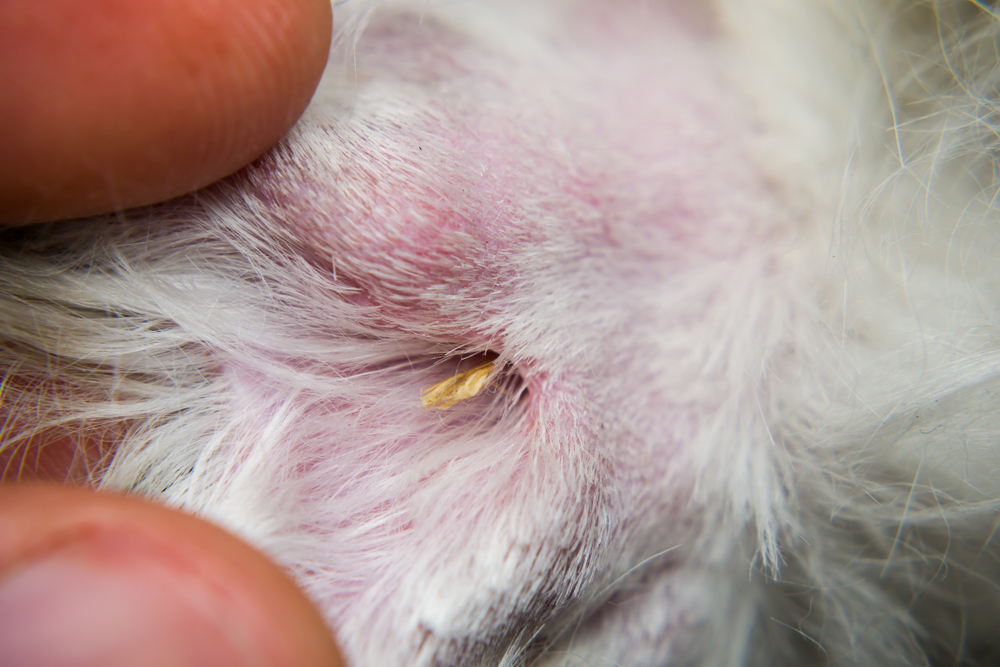
In Northern Arizona, foxtail season runs a long time, and the consequences of a foxtail that finds its way into a nostril, ear canal, paw web, or skin fold can be severe and difficult to detect with conventional imaging. The grass awn that starts as a surface irritant does not always stay there. Foxtails are uniquely evolved to migrate: the barbed structure that allows them to travel through fur also allows them to move through soft tissue, tracking along tissue planes into the chest, abdomen, or spine. By the time a foxtail has migrated internally, its origin point is often undetectable, and finding it becomes a genuinely complex diagnostic challenge.
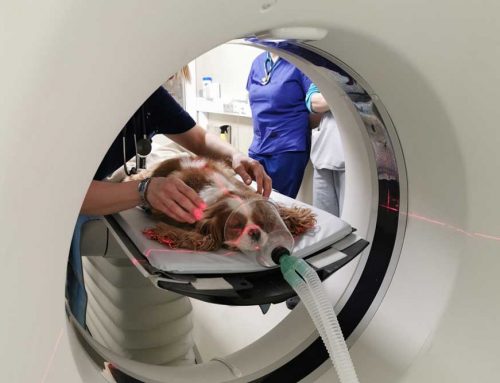
The Veterinary Emergency and Specialty Center of Northern Arizona in Flagstaff has CT imaging available on-site, and that capability changes what is possible when a foxtail has migrated beyond the reach of standard radiographs. Our team is experienced in interpreting the subtle imaging findings that indicate migration, and our surgical capabilities allow us to act quickly once a location is confirmed. If your pet has been showing signs of deep-seated infection, unexplained pain, or a draining tract that will not heal after foxtail season, contact us right away.
At a Glance
- Foxtails are barbed grass awns that only travel one direction once they hook into skin or fur; what looks like a minor surface irritation can migrate through tissue planes into the chest, abdomen, or spine over hours to days.
- Standard X-rays cannot see foxtails because plant material is radiolucent; CT imaging makes the awn, the migration tract, and any secondary infection visible in a way that shapes whether retrieval is straightforward or requires complex surgery.
- The pets at highest risk are those running through tall grass, hiking off-trail, or playing in unmaintained fields during late spring through fall; post-outing inspections take a few minutes and catch most foxtails before they have moved.
- Sudden onset of limping, head shaking, explosive sneezing, persistent licking of one spot, or a non-healing draining wound after outdoor activity all warrant prompt evaluation rather than a wait-and-see approach.
What Are Foxtails and How Do They Cause So Much Trouble?
Foxtails (also called grass awns, spear grass, or cheat grass depending on the region) are the seed-bearing structures of certain wild grasses. Their evolutionary purpose is dispersal: the barbed shape allows them to attach to passing animals, then work their way deeper as the animal moves. The barbs angle backward, which means the awn can only move in one direction. Once it has hooked into fur or skin, normal motion drives it forward. It cannot back out.
This design works perfectly for the grass and is genuinely dangerous for pets. Common exposure settings in Northern Arizona include hiking trails (particularly during late spring through early fall when grasses dry out and seed), unmaintained yards and fields, dirt roads bordered by tall grass, and any area with native or invasive bunch grasses.
The pets at highest exposure risk are those that hike, run off-leash through tall grass, or play in fields. Long-coated breeds collect more awns than short-coated breeds, but no coat type is fully protected. Cats can encounter foxtails too, particularly outdoor cats, though they are less commonly affected than dogs.
Why Are Foxtails More Dangerous Than They Look?
The barbed design that lets foxtails attach also drives them deeper over time. A foxtail that has lodged in a paw web does not fall out. Each step the dog takes, each muscle contraction, each squirm against an itch, drives the awn slightly further into tissue. Over hours to days, the awn can disappear entirely from the surface and be embedded deep within the skin or in muscle layers below.
The complications that develop without prompt treatment include:
- Abscesses at the migration tract, often appearing as draining wounds with no obvious source, often from actinomycosis, a bacterial infection that can follow grass awn migration
- Persistent draining tracts that do not heal despite antibiotic treatment, because the foreign body is still inside
- Chronic otitis externa when foxtails enter the ear canal and cannot be removed; in advanced cases, migration past the eardrum leads to otitis media and interna, which can cause head tilt, balance problems, and neurological signs
- Respiratory complications when foxtails are inhaled, including excessive sneezing, sinus infections, pneumonia, lung abscesses, and pyothorax (pus in the chest)
- Corneal ulcers and other eye injuries that can affect vision when foxtails contact the eye
- Internal organ damage when migrating awns reach the chest or abdominal cavities
- Spinal abscesses in rare cases when migration tracks along nerves toward the spine
The migration patterns are why prompt removal matters so much. A foxtail caught at the surface can be plucked out in minutes. A foxtail that has migrated for several days requires imaging to locate, surgery to remove, and sometimes specialty consultation when the location is anatomically complex.
Why Does CT Scanning Change What’s Possible for Migrating Foxtails?
Standard radiographs (X-rays) have well-known limitations for finding foxtails. Plant material is radiolucent, meaning it does not show up on X-rays the way bone or metal does. A foxtail in soft tissue is invisible on a standard radiograph; what may be visible is the secondary effects (gas pockets, fluid accumulation, soft tissue swelling), but these are non-specific findings that do not distinguish foxtails from other causes of inflammation.
Ultrasound improves on X-rays for some superficial foxtail locations but has its own limitations. Skill and operator experience matter substantially, the awns can be difficult to distinguish from other linear structures, and ultrasound has limited utility for awns deep in the chest or in bony structures.
CT scanning offers significant advantages:
Cross-sectional imaging provides detailed views of every body region without the overlapping structures that confuse plain films. A foxtail in the lung that would be invisible behind ribs on a radiograph can be located precisely on CT.
Identification of migration tracts is often possible. The path the awn has taken through tissue creates inflammation and small abnormalities that are visible on CT even when the awn itself is at the limit of detection. Following these tracks can localize the awn’s current position.
Pre-surgical planning improves dramatically when CT identifies the exact location, depth, and surrounding anatomy of an awn. Surgery becomes more targeted, less invasive, and more likely to succeed in retrieving the foreign body completely.
Detection of complications including abscess formation, pleural effusion, and bony involvement happens in the same scan rather than requiring multiple separate studies.
The CT scanner at our facility is the only one in Northern Arizona, and that is directly relevant to foxtail cases because the alternative is sending pets to Phoenix or other distant centers, with the delays and complications that creates for an actively migrating foreign body.
Where Do Foxtails Hide and What Signs Should You Watch For?
Foxtails can lodge in almost any body region. The locations vary, and so do the warning signs, but the common thread is that something looks off in a way that started after outdoor activity. Knowing where to look and what to look for is what catches awns before migration takes them out of reach.
Paws and between toes are by far the most common location. Signs include sudden onset of limping or favoring one foot, persistent licking or chewing at a paw, swelling between the toes, a draining wound or “pimple” on top of the paw or between toes, and pain when the foot is touched.
Ear canals produce dramatic signs because of how sensitive the ear is. Watch for sudden head shaking, head tilt, scratching at the ear, ear odor, head held to one side, or behavior suggesting pain when the head is touched.
Nasal passages trigger explosive sneezing in the immediate aftermath of inhalation, sometimes followed by repetitive sneezing, nasal discharge (sometimes bloody), pawing at the nose, and chronic nasal symptoms over time.
Eyes present with squinting, redness, tearing, pawing at the eye, and visible discomfort. The classic signs of eye pain in pets include holding the eye closed, light sensitivity, and a sudden change in the appearance of the eye itself. Eye foxtails warrant immediate evaluation; eye injuries and corneal abrasions can develop rapidly and threaten vision.
Under the skin anywhere on the body can produce lumps, abscesses, draining tracts, or non-healing wounds. The location varies based on where the awn entered and how it has migrated.
Less obvious sites include the gums (drooling, mouth pawing, reluctance to eat), genital area (excessive licking, swelling), and rectal area.
Foxtail injuries often produce confusing or intermittent symptoms because of the migration. Your dog might have a lump on their side for a few days, then nothing for a week, then chest symptoms as the awn travels. The episodic nature can lead you to dismiss the issue as resolved when in fact the foxtail is still moving.
What Delayed Signs Should You Watch For After Outdoor Activity?
Symptoms can emerge hours or days after exposure. Foxtails picked up on a Saturday hike may not produce noticeable signs until midweek. Knowing what to look for during the days after an outing, and acting on subtle changes rather than waiting them out, is what keeps awns from migrating into the chest or other hard-to-reach locations.
The subtle behavioral changes that warrant attention after any outdoor activity in foxtail country:
- New limping or favoring of any leg
- Head shaking or scratching at one ear
- Sudden onset of sneezing, particularly explosive bouts
- Coughing without other respiratory symptoms
- New swelling, lumps, or wounds anywhere on the body
- Persistent licking or chewing at one spot
- Changes in eating, drinking, or activity level
- Squinting or eye changes
Respiratory distress signs warrant immediate evaluation. An inhaled foxtail can migrate into the lungs and cause severe complications, sometimes including pneumothorax (collapsed lung) or pyothorax (pus in the chest). Severe respiratory complications can drive a dog into shock and require critical care.
Same-day evaluation when symptoms appear can prevent more invasive procedures later. A foxtail caught at the paw within 24 hours of entry is a quick removal. The same foxtail allowed to migrate for a week may require advanced imaging, surgical exploration, and extended hospitalization.
How Does Veterinary Treatment Address an Awn Injury?
Professional removal is essential. Foxtails do not work themselves out, and home attempts to remove an awn that has begun migrating typically push it deeper rather than retrieve it. The diagnostic and treatment process usually combines a careful exam under sedation, targeted imaging, and surgical or endoscopic retrieval, with antibiotics and pain management around the procedure.
The diagnostic and treatment approach:
Targeted physical examination of the affected area, including all the typical hiding places. The exam often requires sedation, both for patient comfort and to allow thorough searching of areas like the ear canals or paw webs that are difficult to evaluate while the animal is awake.
Imaging when needed:
- Otoscopic exam under sedation for ear foxtails
- Rhinoscopy for nasal awns (a scope passed into the nasal passages)
- CT for any migrating awn, awns that are not found on direct examination, or pre-surgical planning
- Ultrasound for some superficial locations
- Radiographs to identify secondary effects, even though the awn itself is not visible
Surgical or endoscopic retrieval depends on location and accessibility. Some awns can be retrieved through the natural orifice they entered (ear canals, nasal passages). Others require surgical incision over the migration tract.
Cultures and antibiotics address secondary infection. The path a foxtail takes through tissue carries bacteria with it, and abscess formation is common. Cultures guide appropriate antibiotic selection, particularly for awns that have been in place for an extended period.
Pain management including injectable medications and oral pain relief during recovery.
Special considerations apply to specific locations. Eye foxtails require ophthalmic evaluation and treatment to address corneal damage. Nasal awns sometimes require multiple endoscopic attempts because the awn is small and the nasal passages have multiple recesses where it can hide. Ear canal awns may damage the eardrum if migration has progressed.
Multiple awns are not unusual. Your pet with one confirmed foxtail should be evaluated for additional awns, particularly if exposure was significant.
Follow-up rechecks confirm complete removal and monitor healing. Sometimes a foxtail tract continues to drain for weeks after the initial removal, indicating either residual contamination or, occasionally, a missed second awn.
Early treatment consistently leads to simpler outcomes. The foxtails caught early are the ones that resolve quickly with minimal intervention.
What Practical Prevention Strategies Actually Work?
Several proactive steps reduce risk during peak season. None of them are foolproof on their own, but stacked together they make a meaningful difference for pets that spend any real time in foxtail country.
Trail and route selection. Choose mowed or maintained trails over off-trail hiking through tall grass. The paths that look most “wild” are often the highest-risk for foxtail exposure.
Post-outing inspection. Check thoroughly and deeply- remember, they burrow quickly. Look at paws (especially between toes), ears (including in the canal), eyes (try to pull the eyelids open wide), groin (and genital openings), gumline (around and between teeth), and brush out the entire coat after every outdoor activity. The few minutes invested can prevent days of treatment.
Trim fur in high-risk zones. Hair on the bottom of the feet (between paw pads), around the ear openings, and between the toes catches foxtails that might otherwise pass without lodging. Regular grooming reduces debris accumulation overall.

Protective gear. Outfox hoods cover the head and ears during high-risk activities. Protective dog boots cover paws and prevent awns from working into paw webs and between toes, which is the single most common foxtail location. Both look unusual but provide real protection for dogs in heavy foxtail areas and can save you thousands of dollars in vet costs.
Yard maintenance. Mow regularly during foxtail season, remove foxtail-producing grasses where possible, and avoid letting affected areas grow tall.
Activity timing. Foxtails are most dangerous when grasses have dried and seeds have formed. Activity in foxtail-prone areas during late spring through fall carries the highest risk.
Frequently Asked Questions About Grass Awns
How quickly does a foxtail need to be removed?
Sooner is always better. A foxtail caught within hours of attachment can usually be plucked out simply. By 24 to 48 hours, migration has often begun. By a week, the awn may be deep enough to require imaging and surgical retrieval.
Can my pet die from a foxtail?
Yes, in severe cases. Foxtails that migrate to the chest can cause pyothorax or septic complications. Foxtails near the spine can cause neurological damage. Most foxtails do not reach this point because families catch them earlier, but the rare severe cases are why prompt evaluation matters.
Will my regular vet have CT?
CT is generally available only at specialty hospitals and emergency centers. Our facility houses the only CT scanner in Northern Arizona. For complex foxtail cases that have migrated beyond what physical examination and routine imaging can locate, CT is often the necessary next step.
How do I know if my pet has been exposed to foxtails?
If you have been hiking, walking through fields, or in any unmaintained outdoor area during late spring through fall, exposure is possible. Foxtails attach without producing immediate visible signs, so the exposure is not always obvious until symptoms develop.
My dog has a non-healing wound that keeps draining. Could this be a foxtail?
It is a real possibility. Persistent draining tracts that do not respond to antibiotics are classic for retained foreign bodies. Imaging to look for an underlying foxtail is appropriate when wounds are not healing as expected.
Protecting Pets From Hidden Outdoor Hazards
Consistent prevention, routine inspections, and prompt veterinary care keep pets safe during foxtail season. The combination of being aware of where foxtails hide, checking pets carefully after outdoor activity, and seeking evaluation early when symptoms appear is what keeps the typical case manageable.
If your pet has symptoms that suggest a foxtail, particularly if simpler treatment has not resolved them, contact us at the Veterinary Emergency and Specialty Center of Northern Arizona. Our CT imaging and surgical capabilities make us well-suited for the cases where standard approaches have not succeeded.



Leave A Comment